
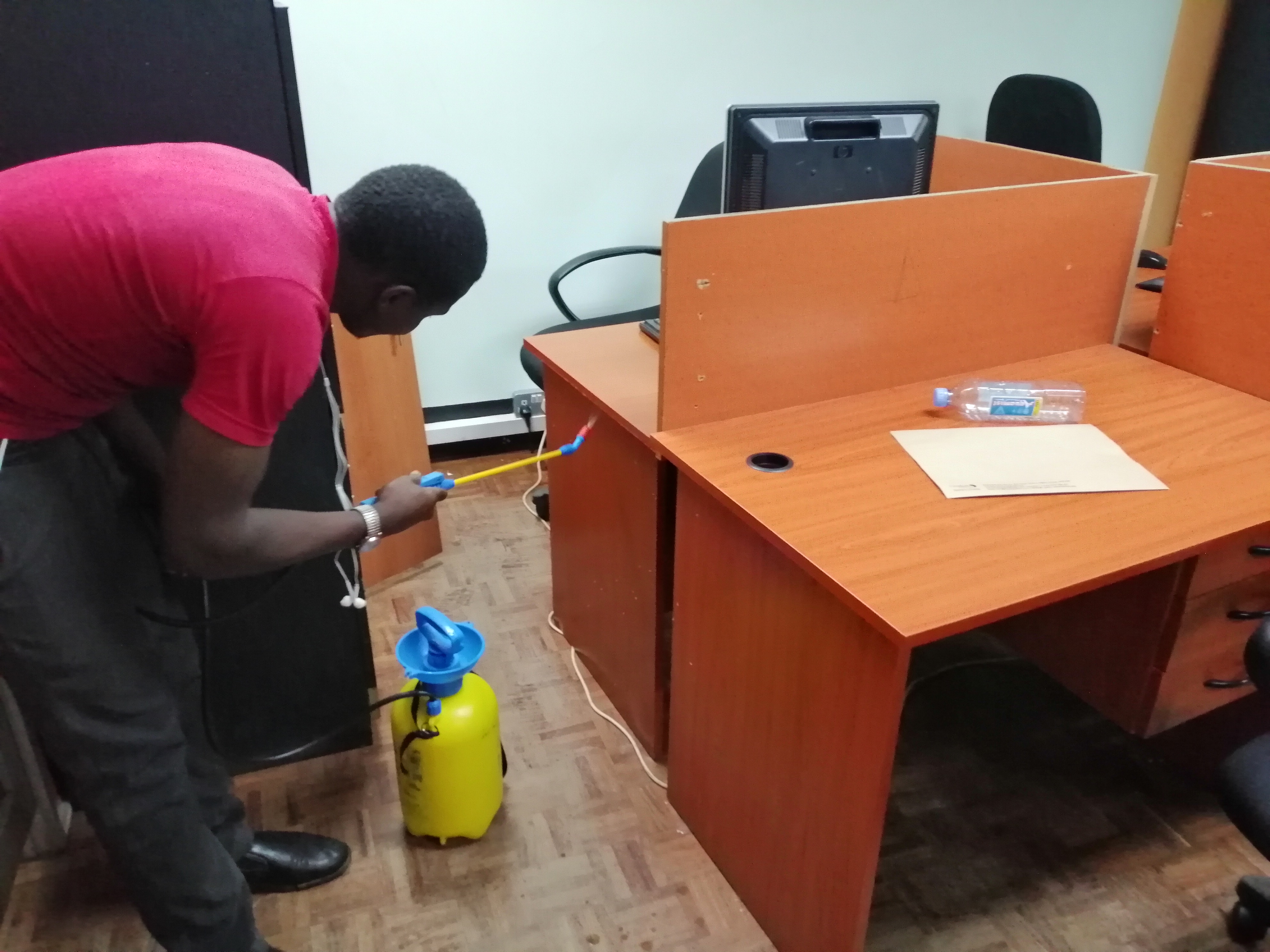
Pest Control & Fumigation
Safe, effective, and guaranteed solutions to keep your property free from pests. We use PCPB-approved products safe for your family and pets.
Information by Pest
Pest control and fumigation services.
We provide comprehensive pest control and fumigation services to keep your home, hotel, school, institution, and vehicle free of pests. Our approaches ensure the safety of your family and pets while effectively getting rid of infestations. Select a pest from the list to learn more about our specific control methods.
Bedbugs
How to get rid of bed bugs in homes, hotels, schools, institutions and vehicles
Bed bugs are small insects that can be confused with small cockroaches on casual observation. To prevent infestation is easier than to get rid of bed bugs. However, after infestation, insecticide spraying can be the only solution. In Kenya, the only method that works to get rid of bed bugs is appropriate insecticide treatment.
An infestation of bed bugs can occur in clean houses and hotels. An infestation with bed bugs therefore does not mean that you are dirty. However, being untidy and keeping clutter will make the bedbugs thrive and multiply. It is also more difficult to get rid of bed bugs in a cluttered or disorganized house.
Gardenscape has rescued many clients who were on the brink of throwing out all their furniture and bedding. Some had moved away from their beds and had been sleeping on the floor. We have met people who have moved out of their houses or were seriously considering abandoning all their property and moving out. An infestation by bed bugs can therefore not be ignored for long. In our experience many do-it-yourself efforts to get rid of bed bugs achieve poor results.
To avoid infestation by bed bugs
New infestation frequently comes from interacting with the infestation. These can be:
- By sleeping elsewhere apart from home such as infested hotels and homes
- Use of public transport like taxis and buses
- Visitors can bring bedbugs from various places that are infested such as their previous residences, educational institutions, hospitals, prisons and from public transport
After a road trip, the following actions will keep you safe from bedbugs:
- On arrival, unpack in the open or in the laundry room. Avoid unpacking in the bedroom, sitting room and any other rooms
- Change clothes and take them to the laundry room as soon as possible. If this is not practical for you, change clothes, bag them in a polythene bag and keep them away from other clothes, beds, seats and other furniture.
- Wash the fabrics as soon as possible and dry them in the sun
To treat infestation
Call Gardenscape Limited on +254 725 932 143 to ensure the safety of children and other occupants of the home or facility is assured. As pest control professionals we understand the insect's behavior and life cycle. Usually, one treatment is enough if the infestation isn't high but if the infestation is high two to three treatments are required to get rid of the bedbugs. We therefore advise that follow up treatment is done.
Fumigant gases containing phosphine should not be used to get rid of bedbugs in residences. This is because the gas destroys electrical items. A reaction occurs between copper and the products of the gas forming a compound. This in effect destroys copper conductors.
To reduce bedbug populations
- Keep the houses and rooms well lit
- Air the bedding, seat covers, cushions and other laundry in the sun
- Keep items like beds, sideboards, bookshelves and clothes away from walls and off the ground
- Regularly clean surfaces and laundry
- Treat new houses before occupying them especially if there were previous tenants or owners
- Treat all second hand furniture immediately after such as beds and sofas before taking them into your house
- Make it a practice to change clothes as soon as you reach home
Preparation for professional treatment
If you call in a pest control professional to get rid of bed bugs in your home or work place, the following preparations will save time:
- Disassemble the beds and keep the mattress to the side of the room
- Remove all cushions and place them on the floor but not on the bed or carpet
- Open all windows
- Remove all curtains and lay them on the floor for easy application of the pesticide
- Have a contact person on hand
- Arrange to have children away for the period advised by the pest control professional
Bedbug control in schools, colleges and boarding institutions
Bedbug infestation is common in schools, colleges and other institutions with boarding facilities. Bedbugs are mainly found in bedding, beds and clothes. Bedbugs can also be carried by anyone, since they don't discriminate on age or background.
Appearance of bedbugs
Adult bedbugs are oval flattened, brown and wingless insects, approximately five to nine millimeters long. After feeding, bedbugs change their color from brown to purplish red.
Common bedbugs biting places
- Head and neck
- Bare arms
- Hands and legs
How to detect bed bugs
The best way is to check where you sleep or rest. Bedbug hiding places include:
- On and around box springs
- Mattresses and buttons of mattresses
- Bed frames
- Desks and chairs
Effects of bedbugs
- Rashes on skins and limbs, depending on the person's immune response
- Visible marks and itchiness, which may make the person uncomfortable
- Sleepiness during daytime due to bed bugs bites during rest
Measures to control bedbugs
1. In personal belongings
- Providing plastic bags or bins to store belongings
- Isolation of belongings to prevent those infested from transferring of bedbugs to others
- Reduce the number of items transported
- Regular inspection of common problem areas
- Avoid accumulation of belongings in one place
2. In facilities
Ensure all facilities are clean and uncluttered. This will facilitate easy identification of bedbugs before the infestation gets established. This can be achieved by regular cleaning of sleeping areas, wall mounted items such as watches and pictures. Where possible, storing items such as bedding and clothing in clear plastic containers will also help achieve this bedbug control.
Significant methods in the control of bed bugs
The most significant action in the control of bed bugs is the seeking of assistance from a professional pest control company. Choices range from chemical to non-chemical solutions.
- Heat treatment: Done by use of specialized equipment that raises temperature to about 48 degrees Celsius. This controls bedbugs effectively at all stages.
- Insecticides: Use of insecticides is another significant method. However, most over-the-counter insecticides are not effective. It's advisable to seek professional assistance.
Cockroaches
How to get rid of cockroaches
Cockroaches are stubborn pests that cause various health and habitation problems to human. In this article, we explain how to get rid of cockroaches in homes, commercial facilities and other facilities.
What are cockroaches
The term cockroach refers to an insect of the order blattodea or blatattaria. The common pest species are the American cockroach (Periplaneta americana), the German cockroach (Blattella germanica), the Oriental cockroach (Blatta orientalis) and the Asian cockroach (Blattella asahinai).
As far as Kenya is concerned, the large cockroach is the American cockroach and the small cockroach is the German cockroach. It is generally difficult to get rid of the German cockroach than it is to get rid of the American cockroach.
Habitats
Cockroaches thrive in warm and humid conditions. In homes, cockroaches hide in dark, warm and humid areas. They can therefore be found in manholes, septic tanks and drain holes. Cockroaches are likely to be seen in kitchens where they hide under refrigerators, in microwaves, in drawers and many other dark places with food. Do not be surprised to find cockroaches in bedrooms. They lay eggs under mattresses and eat food debris dropped in bedrooms.
Behaviour
Many species of cockroaches avoid sudden light and exhibit nocturnal behaviour. In a lit environment, cockroaches will come out to forage for food. Studies have shown that cockroaches exhibit group behaviour of collaboration and competition. One key trait that is relevant on how to get rid of cockroaches is that of leaving chemical trails in faeces. By using these chemical trails, cockroaches can find where other members are hiding and can trace the source of food.
How to get rid of cockroaches: Integrated approaches
Prevention is always better than cure. The first thing is to control the environment so as to make it less appealing to the roaches. This involves cleaning, fixing leaks, eliminating clutter and proper lighting of all areas in a room. These measures will prevent cockroach infestation as well as reducing their population.
To get rid of cockroaches, insecticides must be used. These must be applied so as to have a controlling effect. Since it is generally difficult to wet a cockroach because of its cuticle, the product must have a residual effect to be fatal. The product must reach the cockroaches at their hideouts.
In summary, to get rid of cockroaches, use an integrated approach that involves use of an effective contact poison and a stomach poison. Manufacturers have developed products that act as contact and stomach poisons. The insecticidal gels and powders are ingested by a single member and are transferred to the other members in the hideouts. This effectively gets rids of cockroaches in that hideout. Contact exterminators for advice on the best products and approaches to get rid of cockroaches.
Fleas
Fleas
If you own pets you are probably already familiar with fleas. They are common parasites that feed off of blood and their favorite hosts are usually our furry friends like cats and dogs. They can also end up on your property by hitching rides on rabbits, foxes, birds, rats, mice or any other long-haired animal.
Fleas are wingless insects that are extremely agile and outstanding jumpers. This jumping ability allows them to transfer from one host to another rather easily, including from pets to their humans.
Are fleas dangerous?
As parasites, the greatest concern about the presence of fleas in your home or business comes from their bites. Although these are not painful, they can result in an uncomfortable itch or rash. Your pets could also develop allergies to flea bites.
Signs of a Flea infestation
- Scratching & Biting (Pets): If your dog is constantly scratching and/or biting himself, he may have fleas.
- Presence of Flea Dirt on Pets: Check your pets regularly for flea dirt (small dark specks).
- Red, Infected Skin: Dogs that are allergic to fleas can develop red, irritated or even bald skin.
- Flea Larvae: Much harder to see than the actual fleas, the larvae are a dirty white in color and measure 3 to 5.2mm in length.
- Small bite marks on humans: If you have small red bumps on you it may be flea bites. If you're getting bitten, chances are you have fleas in your bed.
Types of Fleas
- Cat flea: Small, flat and brownish and prefer feline hosts, but can be found on some other hosts, as well.
- Dog flea: Tiny insects, also with flat bodies, and are black in color. They have bristles that allow them to hang on to dog fur.
- Bird flea: Also known as a hen flea. These prefer chickens and can infest an entire hen house very quickly.
Can you eliminate fleas on your own?
That's why you need a fumigation company with experience and the correct combination of effective pesticides to get rid of the flea problem for good.
Spiders
Spiders
Though some spiders are known as being quite fatal, they too have some benefits. For example, spiders help in the control of insects in our homes by feeding on them. This does not mean spiders should be wholly tolerated.
Methods for control of spiders
I. Through barring entry of spiders
It's always said prevention is better than cure. Therefore prevention of spiders from getting into your home is key. This can be achieved through sealing all the cracks and crevices through which the spiders can enter your house. Doors and windows should be regularly inspected so as to ensure there are no holes or openings.
II. Through observing sanitation
Spiders are prone to taking shelter in stuff that are rarely moved in homes. Remove any trash, unused cartons and all other unused items. Regular sweeping and dusting should also be frequently done, not forgetting removal of cob webs.
III. The use of non-chemical method
This can be done through the manual removal of spider eggs. A vacuum cleaner can also be used to destroy the web and egg. Use of sticky insect traps is also employed where they should be placed in corners and along baseboards.
IV. Use of chemical control
Chemical spider control can be achieved through the use of residual insecticides. The insecticides should be sprayed on corners and in places where the spiders spin their webs and lay eggs.
V. Control of spiders outdoors
This is done through the removal of spiders that have their harborage on buildings by use of water under very high pressure.
General preventive techniques
- Tree branches that lead into and touch your home should be trimmed.
- Regular inspection should be carried out on your doors and windows to check whether there is the existence of cracks or holes.
- Keep your compound free of litter, standing water or weeds that may form harborage for pests.
- People should also ensure that litter bins have tight fitting lids. Regular sweeping should also be done around the dust bins.
- All the cracks and gaps inside your house should be sealed as they can form a pathway for spiders.
Flies
Flies and Houseflies
Flies are one of the insects that are totally a nuisance to many people. Flies are carriers of deadly diseases and are fond of facilitating the spread of disease. Flies are very restless thus they hover between food and dirt thereby spreading diseases.
Contamination & Diseases
Flies are always attracted to food by their strong sense of smell. When a fly gets onto a solid food, it vomits on the food thereby creating a solution. The fly then sucks the food. This is how it contaminates the food. Flies cause diseases like typhoid, diarrhoea, dysentery, tuberculosis and cholera.
Preventive measures
- Food should always be well covered since it can be contaminated by the flies upon coming into contact with it.
- All food and liquid materials should always be cleaned upon spillage.
- All food debris under kitchen appliances should also be properly cleaned.
- People should also ensure that all their litter bins have proper lids that can be closed tightly.
- The compost pit should always be covered and enclosed.
- One should always be cleaning up pets refuse; faeces are good breeding places for flies.
Control of house flies
- Find breeding sources: Common breeding sources are food, animal and human waste dump areas, garbage and compost heaps. Clean up the places.
- Use of insect repellents: Like herbs of aromatic plants, smoke and fly repellent oil like eucalyptus oil.
- Use of traps: Human-made fly trap made up of a jar, cone paper and sugar solution, or artificial sticky traps.
- Electrical methods: Handheld electrical fly swatter.
- Chemical sprays: Effective since it instantly kills the flies; however it has effect on the environment.
Mosquitoes
Mosquito Control
Mosquitoes belong to the same group as the true flies. As such, they have a single pair of wings. They typically have long, thin legs and head featuring a prominent proboscis.
Behavior, Diet & Habits
Mosquitoes are best known for habits of the adult females which often feed on blood to help generate their eggs. The lesser-known side is that mosquito adults, males and females, also feed on nectar from flowers. Their immature stages usually are located in standing, preferably stagnant water.
The larvae feed on variety of materials, depending on species. Adult mosquitoes prefer to be most active from dusk until dawn but can become active with sufficient cloud cover or in dark shady areas.
Signs of a Mosquito Infestation
Annoying signs of mosquito activity include the buzzing of the females and their bites. People have differing reaction to bites, ranging from mild irritation to intense inflammation and swelling. Signs of the immature are their presence in standing water, which also can include watering dishes of containerized house plants.
Disease & Treatment
Female mosquitoes have piercing mouthparts through which they extract the blood of a host. While not particularly painful, the bite of a mosquito can prove dangerous to humans through disease transmission. When a mosquito inserts her proboscis through the skin, her saliva creates a small, red bump.
Mosquitoes also carry diseases such as yellow and dengue fevers, malaria and encephalitis and are capable of passing them from host to host.
The use of insect repellents is recommended. After receiving a mosquito bite, a cold compress can be applied to the affected area in order to reduce swelling. Mild antihistamines and anti-itching compounds relieve itching.
Rodents
Rodents (Rats, Moles and Mice)
Rats and mice are a common problem in all parts of the world. You will identify rodent problems by their activity and by seeing them. Rodents will chew on items such as clothes, electrical cables and shoes. You will also hear noises on your roof, ceiling and attic. On close examination, most often you will see their stool.
Control Methods
Chemical control
The most effective way of controlling rodents is the use of anticoagulant baits. These can be put in bait stations to protect the baits themselves from the elements of weather and to protect pets. Keeping them out of reach of children is extremely important. Avoid knockdown chemicals like Zinc Phosphine as they do not work as well because rodents soon learn to avoid them, and they are dangerous poisons.
Mechanical control
- Entry proofing: By blocking rodent pathways and entry ways rodents can be controlled effectively. Use wire nets and ensure that all windows and doors have no gaps.
- Trapping: Many types of traps exist. The most common are trigger traps, cages and glue traps. For all mechanical traps, it is important to inspect the traps regularly to remove the trapped rodents, to replenish the bait, to clean the trap and to reset the trap.
Biological control
Some of the natural predators to rodents include cats, birds of prey and snakes. If they are absent in the ecosystem, rodent populations can explode. Rodents thrive in environments where they can hide, breed and where there is plenty of food. Eliminating these factors minimizes problems associated with rats, mice and other rodents.
Termites
Termite Control
Termites are eusocial insects (insects with a high level of social organization and order). They therefore exist in colonies with division of labour, overlapping adult generations and collective caring of the young ones and each other.
Importance of Termites
- As detrivores contributing to decomposition and the nutrient cycles
- As pests that can cause considerable losses in grains, timber structures, agriculture, forestry and many other materials destruction of an economic nature
The idea of termite control should therefore not be seen as a means of eliminating them from the ecosystem but rather the protection of materials and economic destruction.
How to recognize termites in your home
- Check for mud tubes especially around the house skirting or on timber
- Check for hollowness on timber. Knocking slightly or using a sharp tool can reveal termite damage
Differences between termites and ants
| Ants | Termites |
|---|---|
| The antennae are bent at an angle of ninety degrees | The antennae are straight and parallel to the body |
| The front wings are longer than the hind wings | The wings are roughly equal in length |
How to prevent termites from establishing colonies
- Cover all openings and cracks on the foundation or house slab
- Attend to leaks in time
- Avoid growing flowers, trees and other plants too close to buildings
- Avoid storing timber and wood next to the house for too long
- Avoid rain water from falling too close to the house
- All construction should be preceded by termite treatment
Treatment control measures
Termites can be controlled by physical, chemical and biological means. The most common methods of control are chemical methods.
Ants
Ants
Sugar ants are also known as the 'pharaoh' or 'pavement ants'. This name is due to their liking for sweet foods. Just like any other ant, sugar ants are known to live in colonies. They are known for construction of very small nests and prefer habitats that are warm and dark, for instance, between walls and under floorboards. Sugar ants are a health hazard. This is because they can move from unclean places like bathrooms to kitchen cabinets where they can spread diseases. Moreover, sugar ants even construct their nests inside food.
Prevention of sugar ants
- Always make sure that the kitchen is clean each and every night. Ensure that the sinks and counter tops are effectively cleaned.
- Make sure that all dishes are cleaned after meals since they are an attraction to sugar ants.
- Floors should be swept of food spills after meals so as to starve sugar ants from any food source.
- Daily moping of your dining area and kitchen will also keep them at bay since this eliminates their pheromone trail that attracts other ants.
- If your dining room is carpeted, vacuuming should always be carried out after each and every meal.
- Always empty the trash at least daily so as to eliminate what might become the food source for the sugar ants.
Ways to get rid of sugar ants
Elimination of sugar ants is quite easy. Use of ant baits is the most effective method. Sweet bait are recommended in such instances. The baits contain boric acid which is non-toxic to humans, but then if ingested it might pose some danger. The boric acid contains some chemicals that lure the sugar ants to consume it. After consumption it takes with it part of it to the other members of the colony.
Natural methods:
- Vinegar: Use vinegar to clean surfaces like sinks and counter tops. Vinegar contains a very strong odor that repels the sugar ants.
- Cloves: Contains a pungent smell that usually confuses the sense of sugar ants hence it deters them. The cloves can be placed along windows and under baseboards.
- Boiled water: Trace the pheromone trail of the sugar ants so as to locate their nests. Once you have established their nest location, pour hot water into the nest.
Snakes
Snakes
Snakes are pests. In general people have great fears for snakes and there are many beliefs around snakes. Snakes can be difficult to see in the environment and can go undetected for long periods.
Prevention of snake infestation
- Control of rodents
- Clearing of bushes and grass
- Covering gaps and holes to prevent entry in houses
- Keeping predator pets like cats, ducks and other poultry
In Kenya, Chemical control of snakes is available too. This includes the use of a snake bait that is Nicotine based, going by the name snake fix, the product is excellent for professional pest control. It is not suitable for use at home or by non-professionals because as a bait, it can attract snakes to you if not kept properly or if gloves are not used.
Bees
Bees
Bees are close relatives to ants and wasps. They play a very important role in the sustenance of life on earth. However, they can also be pests.
Bees as pests
Bees can only be considered pests when they endanger the lives of humans, livestock and wildlife. This is only relevant to stinging bees and when they swarm around humans. In general, bees will not sting until disturbed.
Life threatening allergies (anaphylaxis)
To some people, bee stings can cause life threatening allergies known as anaphylaxis. It is therefore extremely important to eliminate bees from human residences especially if there are young children.
Treatment of bee stings
- Remove the stinger as soon as possible
- Apply a weak base/alkali such as tooth paste or soap. Bee sting is highly acidic containing melittin
- A tetanus injection may be required
- For serious reaction, get to a health facility as soon as possible where the doctor may prescribe epinephrine injection
Control of bees
- Fumigation or spraying with an appropriate insecticide will often control bees. Pest control professionals will prescribe control and preventive measures to discourage re-colonization.
- Prevent entry and colonization by entry proofing. Bees will mostly be found in ceilings, chimneys and between panels in a building.
- Where pesticides are used, all the honey and honey combs must be disposed of well by the pest control professionals.
Usually, the control of bees is done in the evening and uses smokers. Appropriate PPE must be worn during the activity.
Bats
Bats
They have a bad reputation and are often thought of as flying rats. Although bats are capable of spreading disease, much like rats, their existence is beneficial to humans and the environment in a way rats are not. The vast majority of bat species are insectivores and maintain a diet of night-flying insects like mosquitoes, beetles, and moths. As these insects are often pests themselves, controlled populations of bats around homes can be considered favorable.
Signs & symptoms of a Bat infestation
- Bat droppings (guano): A bat's droppings can carry a fungus known to cause Histoplasmosis and Cryptocacaous. It's therefore advisable to avoid inhaling the air around the guano.
- Bat Stains: Bats can leave visible grease marks around the area they are inhabiting.
- Bat odor: Bat urine emits a very strong and offensive odor.
- Bat bugs: A bat roost can harbor other parasites such as the bat bug. Bat bugs can easily be confused with bed bugs since they also bite.
- Injured bats: They have a likelihood to bite house occupants if you get close to them.
Habitat & Control
Highly adaptable, bats set up roosts in a variety of environments like deserts, woodlands, suburbs, and urban areas. Bats will use barns, attics, caves, tree cavities, and the undersides of bridges to roost and/or overwinter.
Since bat populations can prove beneficial, some homeowners construct what are known as bat houses close to gardens and around homes in order to keep bats from roosting where they are unwanted. To deter bats, individuals should seal off potential points of entry. In addition to sealing cracks and openings, illuminating attic spaces and eaves during nighttime hours helps deter bats from roosting.
Damage & Threats
While bats are beneficial creatures overall, they do pose certain health threats. Diseases like rabies and histoplasmosis are often associated with bats. Though 99 percent of rabies-related deaths are caused by rabid dogs, bats are still carriers of the disease. Thankfully, even rabid bats refrain from biting humans unless they feel threatened in some way.
Wasps
Wasps
Wasps are considered pests for the painful stings they can inflict. There are over 100 types of wasps in Kenya. Wasp control is warranted in circumstances when a wasps nest is established in an area in close proximity to people and pets.
Paper wasps and bald-faced hornets are particularly aggressive and their stings can lead to fatal anaphylactic shock in rare instances. We provide residential and commercial customers with effective wasp nest removal services.